Category Archives: Uncategorized

Synchronicity: Merry-go-rounds, Steel Slides, Woodstock, Yasgur Road, Chick-A-Boom, Dick Monda and Popcorn

Max Yasgur’s Farm

After a years-long blogging sabbatical, about ten days ago I posted an article that was inspired by a report of a Florida boy falling out of a roller coaster. (It has since been reported that he’s home from the hospital and recovering.)

That incident brought to mind how dangerous amusement park rides were when I was a kid, which further reminded me of how dangerous school playground equipment was back then (Fifties and Sixties). The resultant blog has pictures of a seesaw, monkey bars, swings, and significantly, steel slides and a merry-go-round.

You can read it by clicking on the post to the right entitled Wing (Winganhauppauge) School-Playground, Islip, NY

Within days of posting, I traveled to Bethel, NY, which is where the original Woodstock Music festival took place in 1969. Beginning in 1994, I started visiting Bethel where reunions of various sizes had been taking place nearly every year.

In the very beginning, they were held on the original festival site (without the owner’s permission), which was a nondescript and mostly forgotten cow pasture. Through the seventies and eighties hardly anyone came, but the 20th anniversary in 1989 sparked renewed interest in Woodstock.

More people came in the early nineties, and in 1994, a big 25th anniversary was scheduled for the original site. Though the formal concert was cancelled at the last minute, thousands of people came anyway, and a pretty big rock show was staged (on six flatbed semi-trailers).

In 1996, a recently minted cable TV billionaire named Alan Gerry (pronounce G like Gary), bought the property and declared the site off-limits. With no place for Woodstock celebrants to go, local businessman, Roy Howard, and his wife Jeryl, offered to allow the newly displaced revelers to camp on their Yasgur Road property.    

That was nice of them, and over the years, The Farm became the place to go in Bethel to celebrate the anniversary. Of note: The Farm is where Max Yasgur lived when he agreed to let the original 1969 Woodstock promoters use a section of his property for the festival (the festival site is about two miles from Max’s modest house, which is still there).

Some years the celebrations at The Farm were large, maybe a couple of thousand people. Others were small, maybe a hundred or so. Whatever their size, Roy and Jeryl dealt with lots of municipal permit and code issues that were unpleasant and costly.

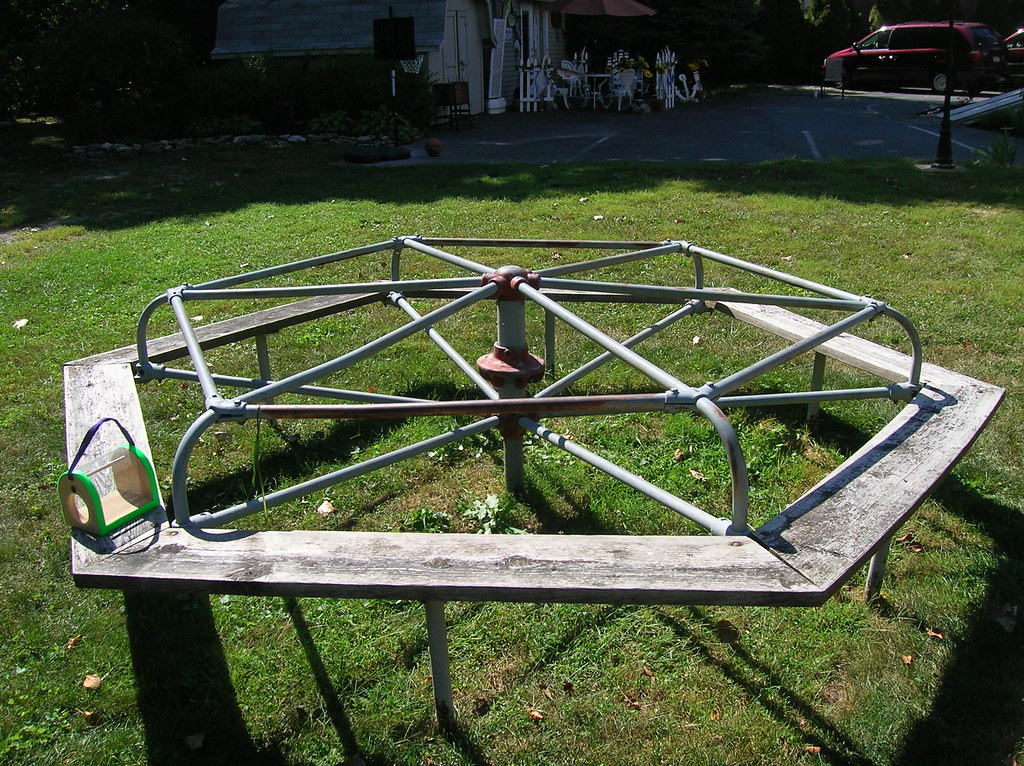
When I go, I camp there. I am familiar with the property, but very soon after I arrived this year, I noticed something: Two Merry-go-rounds (one working, one not) and a steel Slide, both of which are very close in design to those shown in my recent blog.
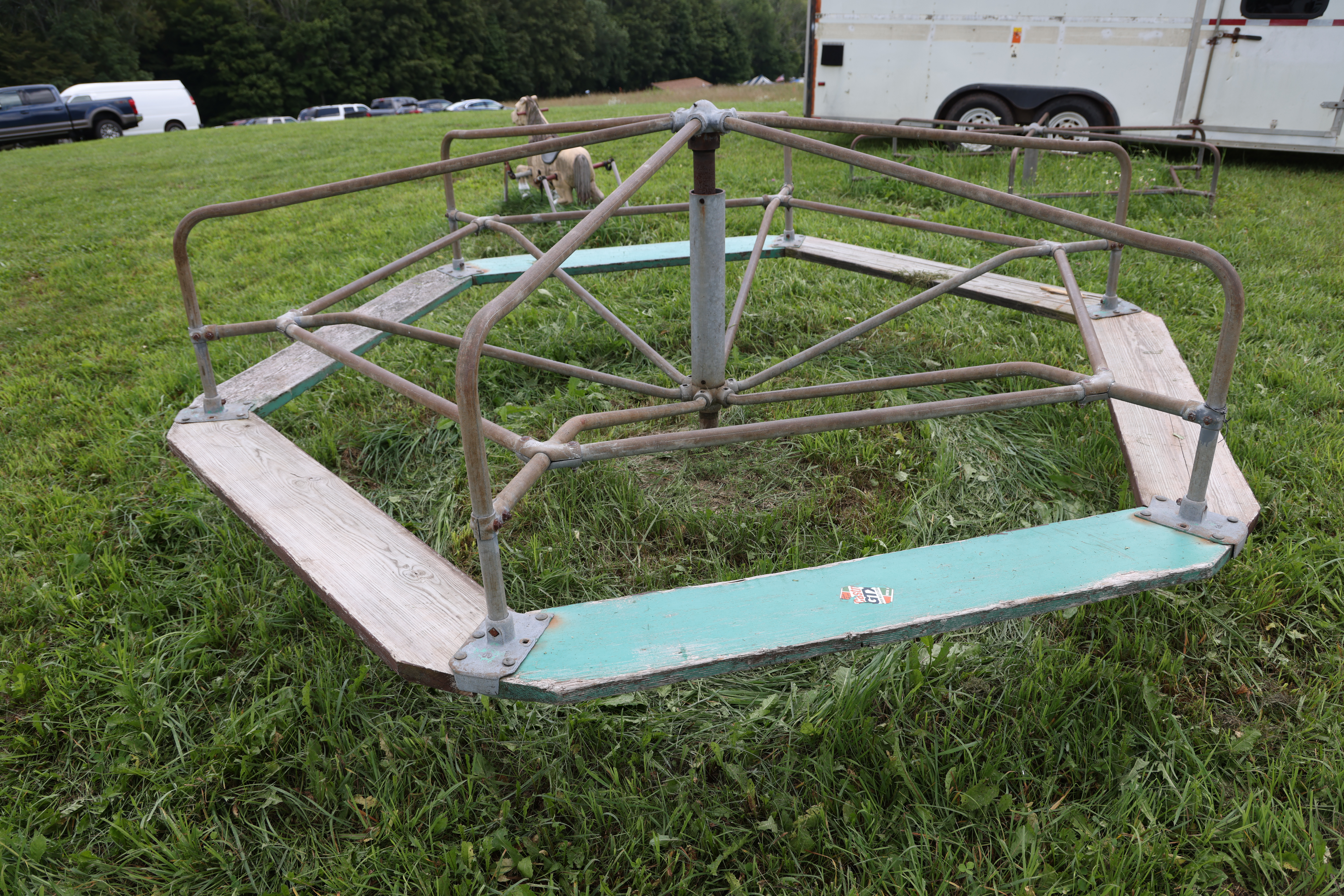
Merry-Go-Round on The Farm (Yasgur Road)

This equipment has been on the property for a while, so I’ve seen it before. Still, it seemed significant that within days of writing about long-forgotten playground apparatus, I found myself camped right alongside it. I took some photos of the equipment.  
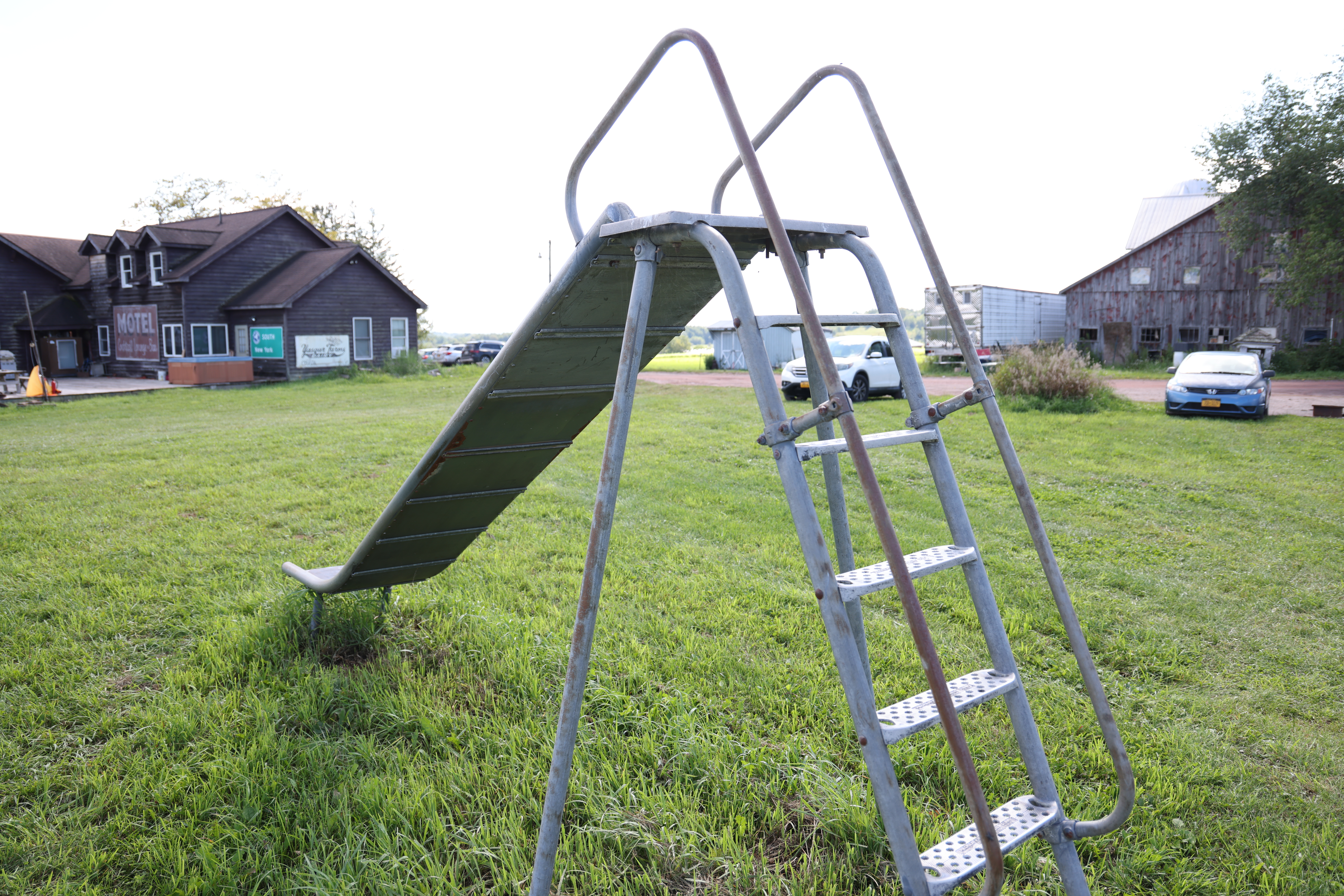
Steel Slide on The Farm (Yasgur Road)

A skeptic might say I wrote about the merry-go-round and slide because I knew I’d be going to Bethel and they somehow rose from my subconscious. I don’t think so. It was the kid falling off the rollercoaster that prompted the post and recollections, so I’m chalking this one up to a very good example of Synchronicity.

Here’s another: WFDU, Daddy Dew Drop, and Chick-a-boom

During the very first week after my visit to Bethel, another odd coincidence occurred. It has nothing to do with Woodstock but makes a musical connection.

In New Jersey there’s a local radio station that is affiliated with Fairleigh Dickenson University. Its call letters are WFDU (listen on the internet: wfdu.fm), and they play a lot of obscure pop songs from the fifties, sixties and seventies. On my first Tuesday back from Bethel, WFDU played a 1971 song called Chick-A-Boom (Don’t Ya Jes’ Love It), by a guy who at the time called himself Daddy Dew Drop.

His real name is Richard “Dick” Monda, who started out as an actor and became a songwriter, performer and music producer. A photo of Mr. Monda if to the right: 

I remembered the song as soon as it came on. It was a massive hit in 1971, reaching number nine on Billboard’s national chart. The song was originally written (by Gwin and Martin) for a television show called “Groovie Goolies,” a program for which Monda had produced music.

I’m not sure if the song ever made it onto the show, but Monda rewrote the lyrics and recorded it with studio musicians. At the time, the story it tells was considered risqué. It recounts a dream where the protagonist follows a girl in a black bikini, who along the way removes parts of it, first the top, then the bottom.

He goes around corners and into rooms, finds himself at a party and comes upon early Rock ‘n’ Roll icon “Little Richard,” (deduced to be him because the lyric reads: “this really far out cat was screaming half-crazy: A-bop-bop-a-loom-op-a-lop-bop-boom,” which is from Richard’s signature song: Tutti Frutti). It might’ve been just some far out cat screaming Little Richard’s catchphrase, but people who comment on such things have assumed it’s Little Richard. Here’s the Chick-A-Boom song:

Daddy Dewdrop’s delivery reminds me of Dr. John, kind of a cool Louisiana drawl, though Monda was from Ohio and grew up in California. It also reminds me a little of Sam the Sham (of Wooly Bully fame, out in 1965) and Tony Joe White (Polk Salad Annie, from 1970, which is such a cool song). Some other internet commenter said Chick-A-Boom reminded him of Eric Burden, and it’s hard to miss the similarities between it and Burden’s “Spill the Wine,” from 1970.

Prior to last Tuesday, I don’t think I’ve thought about the Chick-A-Boom song in at least forty years. Not at all. Not once. The reason songs fade into obscurity is they stop getting played after their time in the sun. That’s what happed to Chick-A-Boom. There’s no explaining why some songs stay in the “oldies” rotation, and others don’t (but it did make it onto the “One Hit Wonders” wall at the Rock ‘n’ Roll Hall of fame.)

A few days after hearing the song, I was at the local Stop and Shop picking up a few things—you know, dinner and stuff. Anyway, I had an urge for popcorn and went to the snack aisle. I am a careful shopper and am always looking for a bargain (as my mother used to say).

The price of snack foods (potato chips, pretzels, corn puffs, corn chips and popcorn) have really gone up lately, and I was scanning the shelves for reasonably priced popcorn. I couldn’t find any. The cheapest was on sale for a little under $4.00, but I figured what the hell, you only live once, and threw a bag into my shopping cart. Here’s a picture of it:

Granted, it would be a more amazing coincidence if the popcorn was called Chick-A-Boom, but damn it, “Boom Chicka Pop” is close enough to put it squarely in the Synchronicity category.

A skeptic might say that the Chick-A-Boom song was floating around in my subconscious and that was what drove me to buy the Boom Chicka Pop brand. I would say I bought it because of its low price, but who the hell knows when it comes to subliminal motivations which nobody really understands. After all, the brain is a pretty complex and mysterious thing.

But still, it seems the universe is sending messages. If only it would include next week’s lottery numbers.

Until next time patient reader, adieu.        
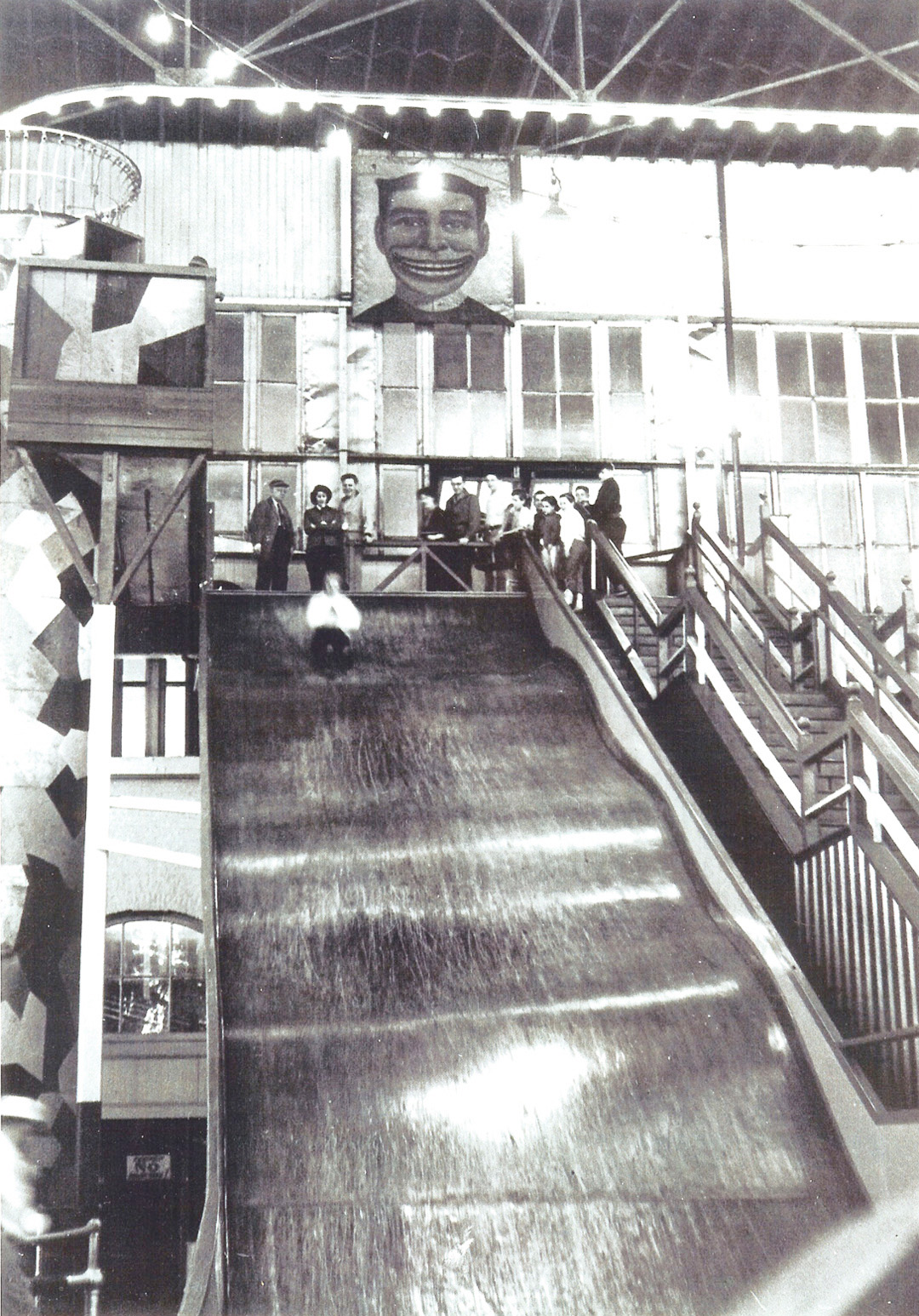
Wing (Winganhauppauge) School Playground, Islip NY

Winganhauppauge School Playground – Islip, NY

The subject of playgrounds came up the other day. It started with news of a child falling off a rollercoaster in Kissimmee Florida. We were surprised because people are usually “yoked” into modern rollercoasters. (From what I’ve since seen, I don’t believe yokes were used on this ride).

This led to my reminiscing over how inadequately I was held into Coney Island’s Tornado rollercoaster back when my mother took me on it when I was about five (around 1957 or so). The restraint was an approximately 3/8ths inch metal bar that was pressed and locked across both rider’s laps, which could be pretty far away from a child’s body if riding with an adult. The coaster terrified me, but that didn’t keep mom from laughing like crazy as the two of us were tossed about in the rickety wooden cab.

The Tornado and the larger Cyclone were part of what is generally called Coney Island, which offered all kinds of entertainment, including “fun houses,” bumper cars, risqué burlesque shows, games of skill and chance, photographers (where my grandmother told me poor people went for family portraits, of which we have a couple), and a variety of places to eat (Nathan’s hotdogs are still sold there). Its boardwalk abuts a three-mile-long public beach.

It was also once home to a place called Steeplechase, which opened in 1897, had a couple of fires and as many rebuilds, and closed for good in 1964. Steeplechase was a very large building with mostly indoor rides, many quite dangerous.

After we moved from Brooklyn to Islip, Long Island, New York, I became a paperboy for Newsday, who arranged a visit back to Coney Island and Steeplechase as a reward for signing up new subscribers.

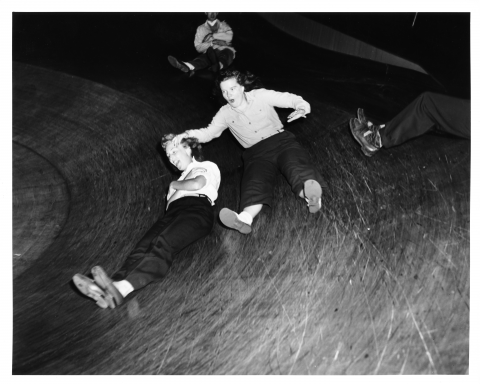
Inside Steeplechase there was what was considered at the time a giant slide, whose surface was like a “gym floor.” At the top riders were given pieces of burlap, and an attendant helped you arrange it into sort of a cloth toboggan. You were cautioned not to put your bare shoe against the slick floor as it might launch you into a painful tumble to the bottom.

If you made it safely down, you went sliding into large bowl, made of the same slick “gym floor” material.

This was supposed to be part of the fun, which rumor had it might include dresses flying up in the air. But it wasn’t all fun and games. There weren’t any pads or mats on the edges of the bowl, and you could easily conk your head against them. As more bodies came flinging into the bowl, it was smart to scamper out of their way as quickly as you could.

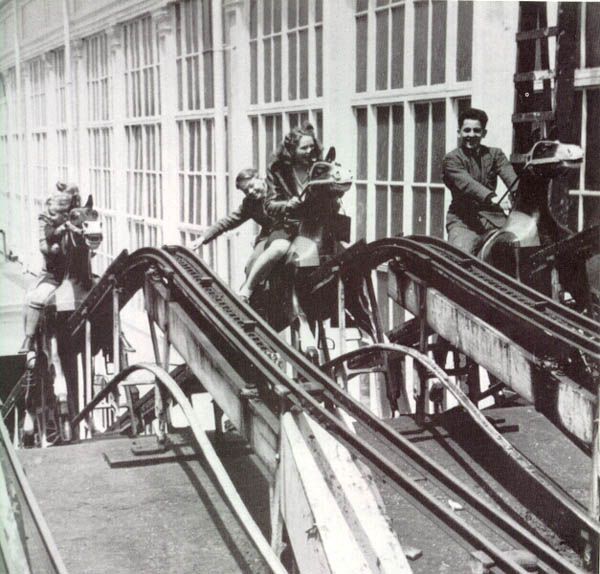
Another ride was “The Steeplechase,” which were these wooden or ceramic horses that you got on and raced around the outside of the building.

The only safety gear was a leather strap they put around your waist, and it was obvious that you could easily slide out of the saddle. At its best, the strap might tether your dangling body to the horse until it stopped. Let’s face it, It was a different time.

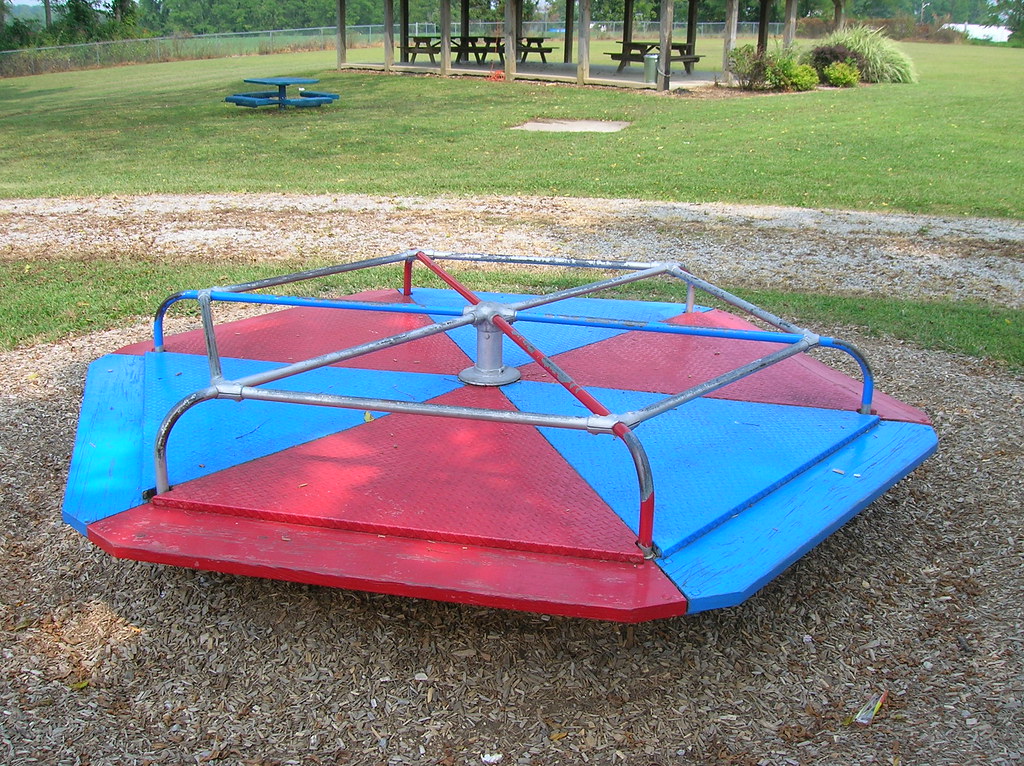
Recollections of these dangerous amusements reminded of the merry-go-round that was on the playground of the Winganhauppauge School in Islip. I don’t think anyone has a picture of the actual ride, but I found one that I think is close.

Me and several other male class members of the class would run and get it spinning as fast as we could, and then leap onto the wooden seats. When it slowed down, we’d jump off and get it going again. This was fun, but there was another reason we did this: it was to terrify the girls and impress them with our immature antics. I don’t think this worked very well.

If a rider somehow found themselves in the center of the spinning contraption, it could easily break their arm or leg, cut them or seriously injure their head. I don’t remember this ever happening, but that doesn’t mean it didn’t.

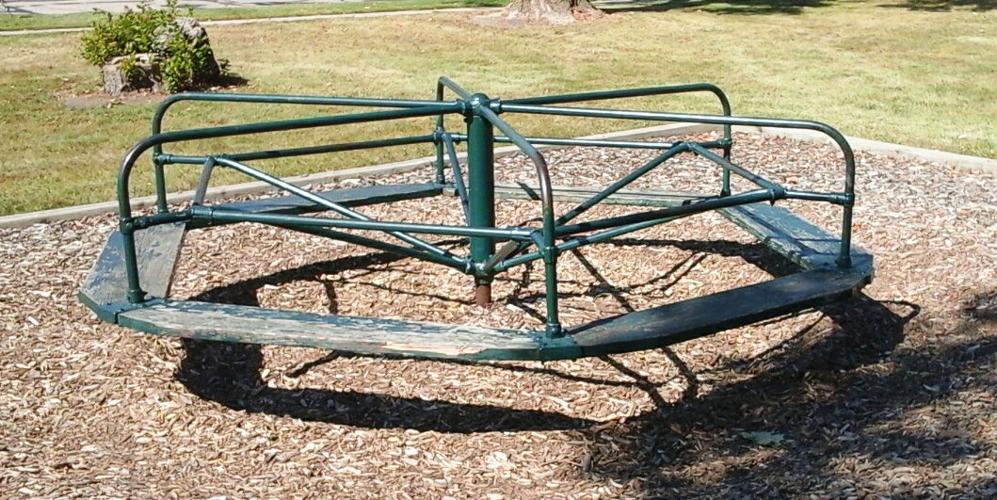
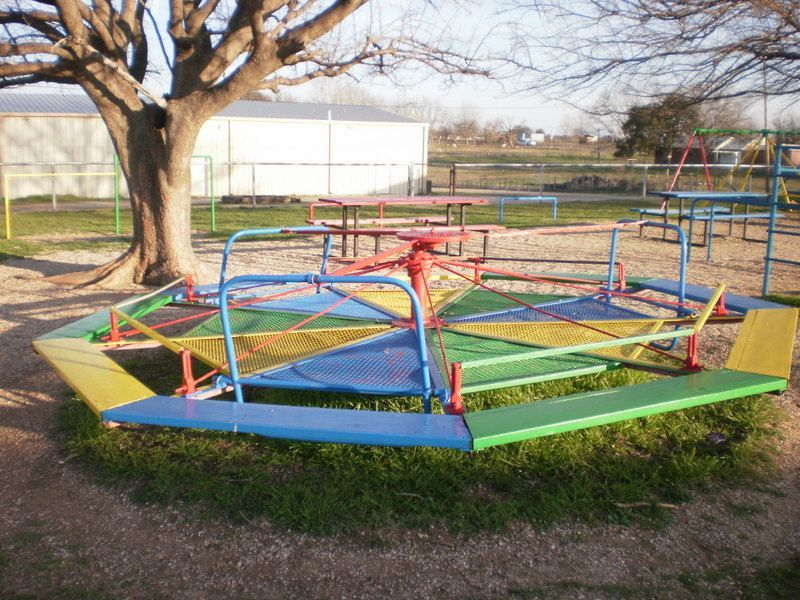
Other versions of these things were made in an attempt to make them a bit safer, like the one below where the spokes slope upward from the center, whereby they might pass harmlessly above your prone body. If you landed closer to the axel however, you were still in for a pretty thorough body of head thumping.

Some “safety fanatic” engineer, came up with the idea of covering the center of the whirling horizontal windmill, making it impossible to fall into its center. However, sitting on it looks like it would’ve been awkward and uncomfortable.

Nor did it address the issue of the centrifugal force flinging you off the spinning discus as prepubescent boys mocked you for your inability to hold on.

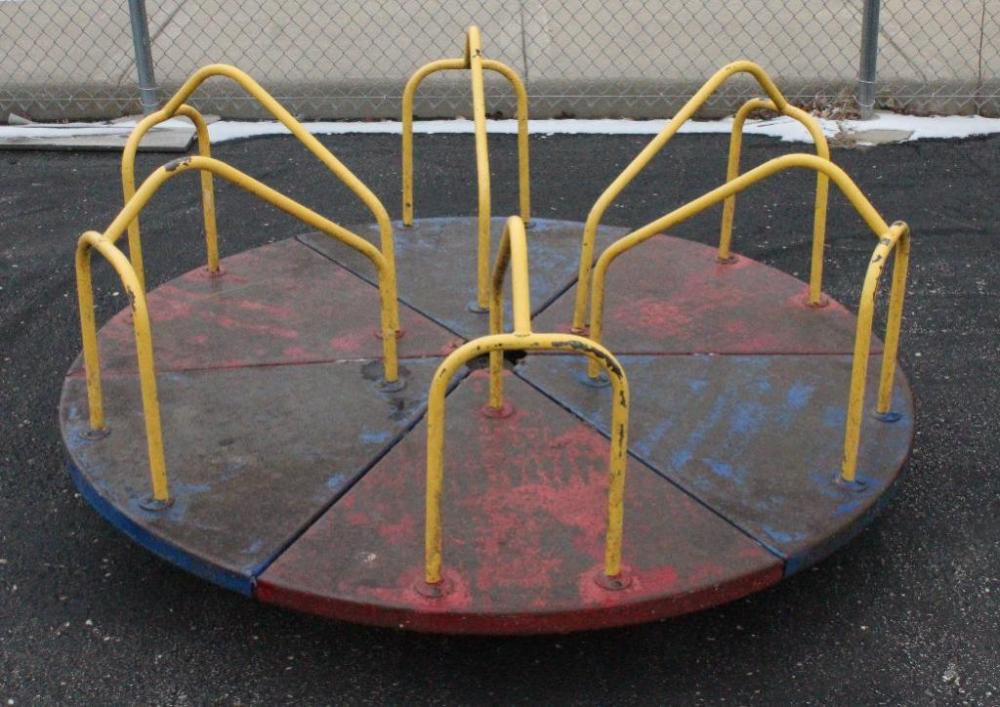
The halfway design change below strived to preserve a child’s ability to sit facing inward while protecting them from the treacherous spokes.

The problem is that the gap for legs is wide enough for a lot of kids to slide all the way through and get mauled by passing little feet or sections of the rotating iron beams.  

Another “safety nanny” thought up a solution where the whole thing was brought closer to the ground, so at least you couldn’t fall in or under it (I hope!).

With this change, you had to stand as you spun, which I guess is okay. You could still get flung from the spinning platter, but you wouldn’t fall as far. If you stood at its side and leaned in, the iron handrails could whack you in the head—but you’re not supposed to do that!

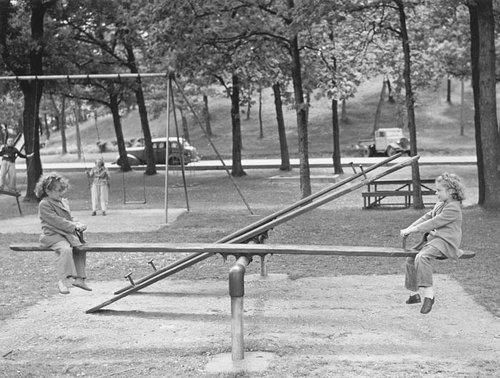
But it wasn’t just the merry-go-round that was dangerous. Seesaws were plenty treacherous.

I loved them, until the day a fellow classmate thought it would be “funny” to slide off his end when I was at maximum height. This sent me into a spine-compressing deadfall that was excruciating and probably actionable.

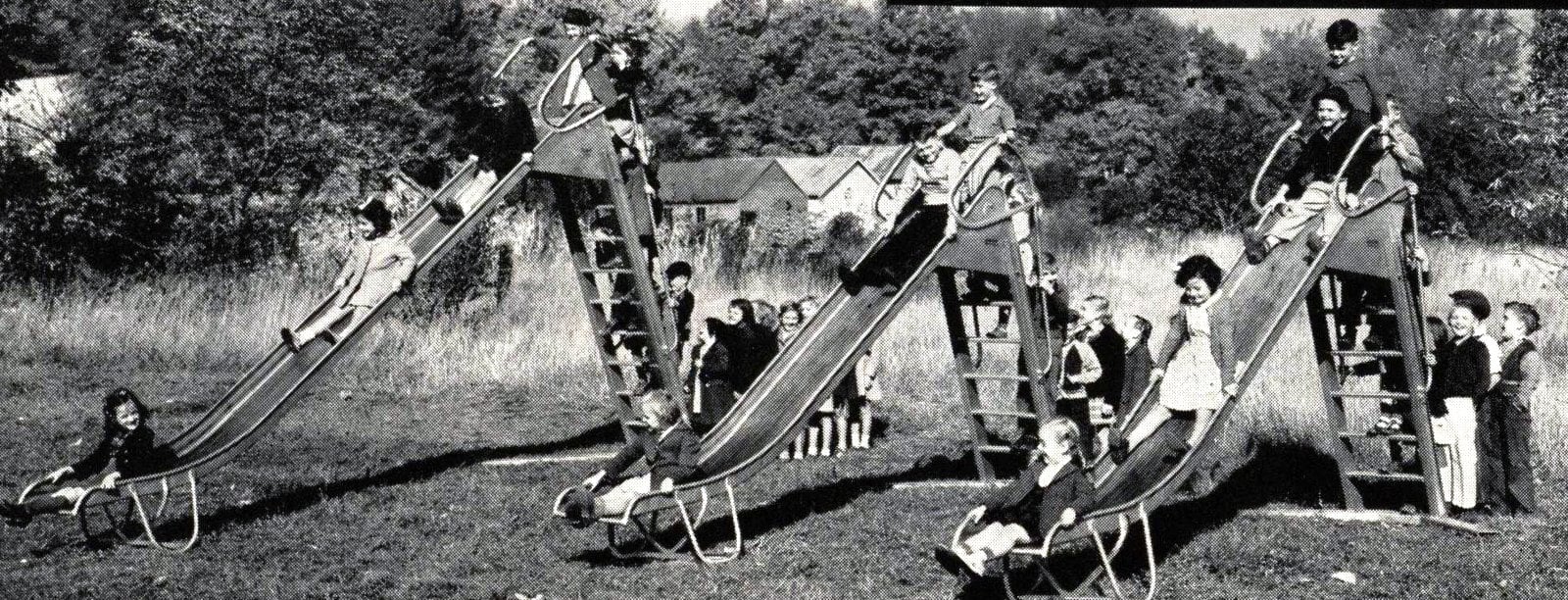
And then there was the steel slide, that as I recall was probably over ten feet tall.

At the top, there was a moment when you briefly stood as kids behind you moved and jostled their way for the next position. When you sat down, you might experience the 160–175 degree temperature (some say 200 degrees) that steel slides reach when exposed to direct sunlight. At least us boys had pants on.

The objective was to go down as fast as possible, so some of us lifted our legs and slid on our backs, launching us off the end of the slide into a hard back landing. It was wise to quickly move aside as there were other kids coming in hot from behind.

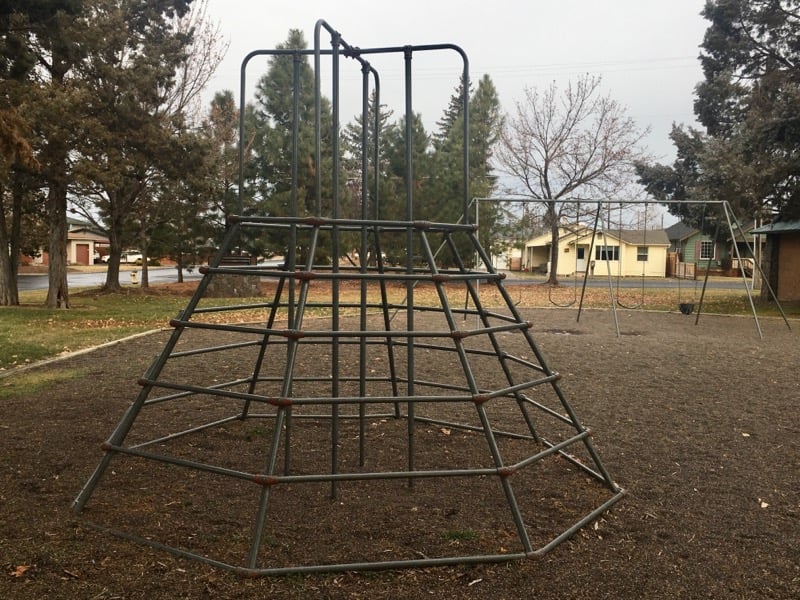
And then there were the monkey bars, which at Wing had four poles in the center down which we slid. I believe this set is a perfect match for the ones at Wing.

Some of the more athletic kids liked to climb and stand on the very top of the jungle gym. Other kids (boys again) opted to thrill us with their Superman impersonations by jumping off the top rungs. Why weren’t they stopped?

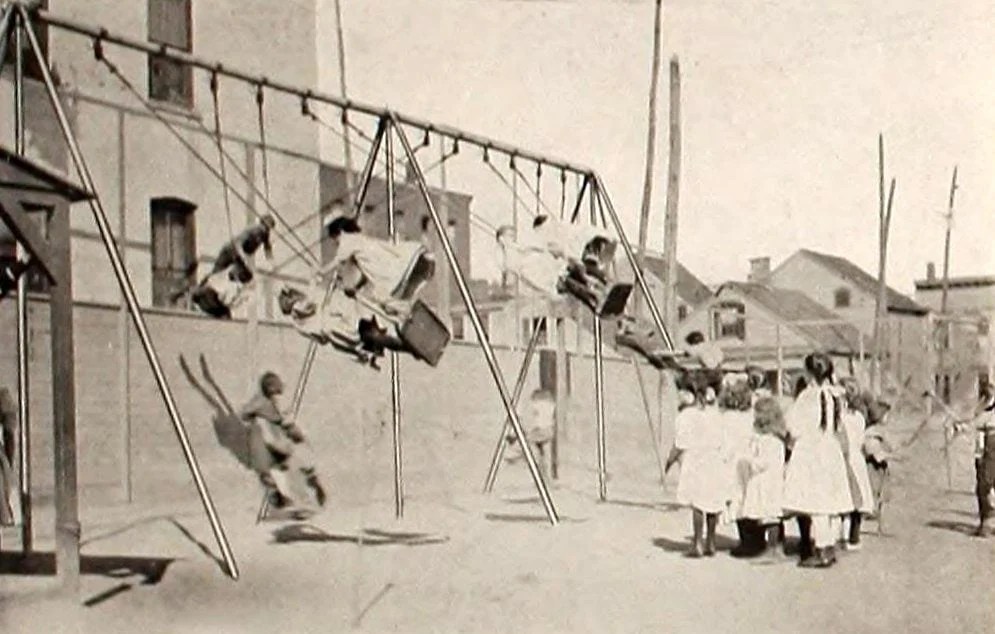
And then there were the swings, which I remember as being pretty high, but nothing like the ones down at Islip Beach, which were fantastic! The ones shown to the right are like the ones at the beach. Wing’s were lower but still pretty respectable.

I need to mention that the playground at Wing was enclosed by a gated, four-foot, chain-link fence, and the ground was covered with sand, which I’m sure stray cats loved to visit.  

One night me and some friends were hanging out at the playground. We were probably in seventh or eighth grade, but still enjoyed riding the swings. One of my more daring friends displayed his acrobatic chops by swinging very high, and at the maximum of his backswing (that place where you’re neither rising or falling), he leaned forward and dropped onto the sand.

The first time he did it, he landed on hands and knees, but after a while, took it a step further. At that “still” section of the backswing, he somersaulted forward and landed this time on his feet.

I had done the relatively tame “drop” maneuver but left the flips to my more acrobatic chums. But another of them, however (and I will not repeat his name to save him from embarrassment), wanted to give it a go.

His attempt started reasonably well. At the maximum point in the backswing, he leaned forward and began his flip, but it stalled when he was completely upside down! My memory of this goes in slow motion.

As his body dropped closer to the sand, it was clear that he was going in for a full faceplant. If my friend was a female yoga teacher in a black leotard, the figure below shows about how he landed, except for the outstretched arms and the fancy watch.

There were a few silent moments after this, as most of us thought we had just watched someone die. Miraculously, soon after our chum’s inverted body toppled over, he was kneeling, appearing stunned, angry, in pain and mortified. With the tips of his fingers he gently wiped sand from his somewhat rearranged face, and it was plain that getting it out of his eyes was going to be a problem.

Somebody asked if he was okay, and he must have heard the small measure of mirth behind the question, which threw him into a rage. Who’s laughing, he loudly demanded, which for me and the rest of the lads was invitation enough to begin a round of merciless and derisive laughter. It went on for quite some time.

The fenced-in playground is long gone, but even in light of what would now be considered a total disregard for our safety, it still holds many fond memories for me.

Yes, it was a different time. ‘Till next time.

CEO Pay. The Rich Get Richer

On April 24th, 2021, the New York Times reported that many CEO’s of American companies hit by fallout from the Covid crisis, received huge salaries and bonuses anyway. Here’s their list of the top twenty highest paid CEO’s in America, put to a beguiling tune by the Flying Lizards.

When an average CEO’s salary is compared to a typical worker’s, a steep upward trend is obvious. In the sixties, people were outraged by a ratio of 21-to-1. By 1989 the gap tripled to 61-to-1—but they were just picking up steam. In 2019, it went to 320-to-1!

Put another way, from 1978 to 2019, inflation adjusted compensation for the typical worker grew 14 percent, and for CEO’s: 1,167 percent. Good work if you can get it, but no one seems to care.

You seldom see people picketing company headquarters or loudly denouncing the self-dealing that leads to these remuneration travesties. Instead, more outrage is directed at how Mr. Potato Head will no longer be called “Mr.,” and the discontinuation of a couple of unpopular Dr. Seuss books. That the rich don’t seem able to get enough, well, that’s something that just can’t be helped.

An oft repeated lament is: The rich get richer, and the statistics bear it out. In 1968, the top-earning 20% of households brought in 43% of the nation’s income. In 2018, the same group was getting 52%.

In 2019, the top 1% of Americans had a combined net worth of $34.2 trillion, which is about a third of all household wealth in the U.S. Conversely, the bottom half of the population holds just $2.1 trillion, or 1.9%.

What’s Good for General Motors

In 1950, Charles E. Wilson, who was president of General Motors Corp., received the highest compensation paid by any public U.S. company. In total, he received $626,300, comprised of a salary of $201,300, $61,205 in GM stock, and cash payments totaling $363,795 to be paid out over the subsequent five years. In today’s dollars, that would be about $ 7 million, which at the time was an absolutely outrageous sum. Not so much when compared to today’s glutinous excesses.

Charlie’s pay took into account the income tax rates of 1950, which for pay over $200,000 was 91%, of which only $1,300 would be taxed at the maximum rate ($201,300 – $200,000 = $1,300). GM deferred another $363,795 in pay over the next five years, and whether or not that was a successful tax avoidance strategy would depend on future earnings or changes in tax law.

Beginning in the fifties, the federal government gave beneficial treatment to stock awards, which is reflected in Mr. Wilson’s $61,205 worth of GM stock. By the end of the decade, such awards and options would account for about half of all executive compensation.

In 1953, Mr. Wilson joined the Eisenhower administration as Secretary of Defense. During his confirmation hearing, his ownership of $2.5 million in GM stock prompted someone to ask if he could make a decision as Secretary of Defense that would be adverse to the interests of General Motors. Wilson said he could and added that he’d always believed that what was good for our country was good for General Motors, and vice versa.

In popular culture, the quip was shortened to “What’s good for General Motors is good for the country,” which he thought mischaracterized his original, more nuanced meaning, but it was the shortened version of the quote that stuck. Ultimately, Mr. Wilson was forced to divest the stock.

Stock awards and options continued through the fifties and sixties, but fell out of favor during the seventies (due to a soft stock market). Stock options came back in the eighties, as a way—the theory went—to make CEO’s act more like entrepreneurs, i.e., tie rewards and penalties to performance.

Pay via stock options was further boosted in 1994 when the Federal government capped the deduction for cash pay to executives at $1 million, with no such limitations on performance-linked compensation. Companies quickly restructured pay plans, which resulted in large and ongoing increases in option grants to CEO’s.

These grants provided incentive for the executives to improve stock prices, which for the nation led to all kinds of adverse, unintended consequences. The worst of these was the closing of thousands of US factories and the exportation of millions of American jobs to China and other low labor-cost nations.

While American CEO’s pocketed enormous amounts of coin, and stockholders saw their net worth climb, the gains were paid for by low-skill, working class Americans who could no longer earn a living wage at the local mill because the factory had been sacrificed on the alter of higher stock prices.

It’s always been said that a corporation’s executives had to answer to only one audience, and that was its stockholders. That is pretty much how it’s been, but in the days before low-cost ocean freight and instantaneous, world-wide communications, cost cutting meant moving a plant from New York to Wichita—or maybe decreasing how much cereal came in the box.

The advent of globalization however, gave the captains of many American industries new options that foreseeably wouldn’t result in positive outcomes for the nation. Companies no longer had to deal with stubborn labor unions who always wanted more. High-cost factories could be closed, and expensive labor could be replaced by workers making a tenth as much—and who knew if they had healthcare or decent working conditions. That was somebody else’s problem.

Nonsense was spun that the march of globalization was inexorable and would ultimately be a net positive for the country. Terms like creative destruction were bandied about as gospel, and people who should’ve known better nodded their heads. It was said that low-skill jobs would somehow be magically replaced by better, high-skill and more fulfilling occupations, as company towns all over the country died and turned into places of despair and hopelessness.

Another quick way of driving up profits was booking profits in other, low-tax countries. If that didn’t goose the stock price enough, the entire company could be uprooted and moved overseas, eradicating more American jobs and profits that were once viewed as foundational to the country.

In the seventy years since Charles E. Wilson expressed his heartfelt opinion that what was good for American business couldn’t help but be good for America, it’s clear that it’s no longer the case.

Before these CEO’s cost-save the United States into third-world status, America’s policy makers need to acknowledge this reality so work can begin to repair the damage done to the nation’s economic engine.

Cheers!

Joe Nolan

Go Another Documentary Film

In 2006, my older brother Phil C. Nolan ran for the position of Islip Town Supervisor, which is akin to being Mayor. It would be his third try.

Beginning with my father, Phil J. Nolan, the Nolan family had waged many political campaigns in Islip N.Y., and as Democrats in a heavily Republican area, we were defeated more often than not.

As we geared up for the race, I feared that it might be the last time my father would campaign with us and decided to document my brother’s somewhat quixotic pursuit. It resulted in my movie: Go Another.

Unfortunately, the feeling I had turned out to be prescient, and Philip J. died shortly after his son was sworn in. As the race recedes further into the past, I see this movie as a pretty good object lesson in the benefits of never giving up. At the same time, the movie is a tribute to my father—and mother—who built a family that stuck together and won a few—quite a few—along the way.

Cheers,

Joe

Chris Christie’s Colossal Infrastructure Blunder

Over ten years ago, New Jersey’s Governor Chris Christie cancelled what at the time would have been the biggest public works project in America. It was called “Access to the Region’s Core,” or ARC. For the first time in over a hundred years two new commuter rail tunnels would be dug under the Hudson River.

When the newly elected Governor Chris Christie cancelled it, he claimed that it was because the state of New Jersey couldn’t afford it—even though New Jersey was only paying for about 15% of the total, and the preceding governor had put in place funding for the state’s share. Almost immediately, public transportation advocates and political opponents challenged his explanation.

As a follower of the project and the fifteen years it took to get it started, I came to believe a major opportunity had been missed—and not for the right reasons. This documentary is my take on what happened to the project and the long term negative impact it’s cancellation had on the region and the environment. It’s effect on Christie’s Political career is examined, as well as his new role as a talk-show pundit who still has designs on the White House.

With a new pro-public transportation and infrastructure Administration in Washington, it now looks like some version of ARC will be built. That is a good thing.

For any prior readers of this blog, you might have noticed that I’ve dropped the tagline: “Everything Reminds Me Of Something Else” from the header. Everything still reminds me of something else, but I decided to make these posts about just one thing at a time. Who knows, maybe I’ll be moved to create more of them.

Joe

Artie Kornfeld, Flower Girls and Blackjack

For quite awhile now, I’ve been returning to Bethel, New York for the anniversary of the Woodstock Music and Arts Fair. When I first started going back, we camped out on the original grounds — which were privately owned — and a few times managed to have an impromptu and totally illegal music festival. It was definitely low rent — and wonderful.

One of the stops I make every year is Hector’s Inn, which was where the bus from Port Authority dropped off me and Jimmy Barnett back in 1969. There really was a Hector, who was kind of famous for buying several truckloads of beer and selling it to Hippies at reasonable prices. Many years later I met him and told him that one of the first things I did when I got to Woodstock was buy one of those six packs. By then he was in poor health, but my story brought a little smile to his lips.

Across the street from Hectors is my Friend Larry Houman’s place, who married Hector’s daughter, Carol. They had set up a little shop that sells Woodstock memorabilia — which surprisingly is one of only a few in the area.

On Anniversary weekend, a lot of people show up at Larry’s and Hector’s, and this year that group included Arty Kornfeld, one of the two promoters who conceived of Woodstock and are most closely associate with it. I made a little movie about his visit. When you’re done watching, come back to this post to see what our little chat reminded me of.

Everything Reminds Me of Something Else

Artie helped write the Cowsill’s hit: The Rain, the Park and Other Things, and you probably heard the guy in the video getting sentimental over how much he loved the song. I’ve always had a soft spot in my heart for the song (and flower girls), but the melody reminds me of when I was about fifteen years old and working as a Caddy at the Timber Point Country Club on Long Island. One of the kids who caddied there was a guy from Central Islip named Mousy.

Jimmy and I used to get up early and walk a couple of miles to Main Street and catch an eastbound bus on Montauk Highway, which dropped us pretty close to Great River road. All the caddies congregated there to wait for the “rich guys” in their Cadillacs to give us a ride to the country club — and they always did.

I met a lot of interesting men who belonged to that country club, and for the most part they were decent guys. The really interesting people were the caddies — which were kind of a mid-sixties cross between the Little Rascals and the Dead End Kids — even though a few of them were grown men.

There was Mister Turtle, who had to be in his sixties and as one might guess, made his way up the fairway at an exceeding slow pace. Another was Glub-Glub, so named for a speech impediment that clearly was the result of some kind of mental impairment — we Caddies were not know for our sensibilities.

There were a few local kids from the somewhat tony town of Great River, who showed up to earn a little spending money, but most of the other kids were from locals that were a few rungs lower on the socio-economic ladder. Some had already dropped out of high school — or soon would.

There was a “pen” where caddies would do what my mother called Shaping Up, which meant waiting for a job assignment — which didn’t always come. Carrying one golfer’s bag paid five dollars and twice that if you carried two. If the guy was worth a damn, he’d buy you a hot dog at the turn and usually tipped a buck or two on top of the rate. It could take five or so hours to get a round in, but back then, five or ten dollars went a pretty long way.

Sometimes you waited a good long time to Get Out, and being the good juvenile delinquents in the making that we were, we passed the time smoking cigarettes and playing Blackjack, which was where I was first exposed to high stakes gambling, which is a relative thing.

In the morning — before anyone got paid — you bet a quarter a hand. In the afternoon — after everyone collected their pay — the minimum shot up to a buck. It was entirely possible to lose in five minutes the money that took you a day to make, something I did once and will never forget.

At any given time there might have been eight or nine kids crowded around the small table we played on, with a another row or two behind them waiting to play. This was when the guys who bankrolled the house and dealt the cards got serious. After all, separating teenager punks from their hard earned cash paid better than carrying golf bags.

They dealt fast, and were on the lookout for anyone swapping cards. One day the dealer — a guy named George who had to be in his thirties and had a bump on the crown of his forehead that was way too similar in size to a golf ball — declared that no one could look at their cards until it was time to play them.

But Mousy fond this restriction an outrage, and refused to observe it. I can still remember him protesting: “We can look at our cards, Man,” and George answering just as insistently that if he did, he would not be allowed to play. Mousy would not give in, and after awhile a couple of the other players sided with him and George relented.

I was pretty sure Mousy was doing some card swapping or cheating in some other way, but I can remember his look of satisfaction as he peered at his cards and considered whether to hit or stay – as he began to softly sing Artie’s song.

Suddenly the sun broke through
(see the sun)
I turned around, she was gone
(where did she go)
and all I had left, was one little flower in my hair

But I knew
(I knew, I knew, I knew, I knew)
she had made me happy
(happy, happy…she had made me very happy)
Flowers in her hair, Flowers everywhere

I love the flower girl (I love the flower girl)
was she reality or just a dream to me
I love the flower girl (I love the flower girl)
well love show’d me the way to find a sunny day
(sunny day, sunny day, sunny day)

I love the flower girl (I love the flower girl)
was she reality or just a dream to me

‘Till next time friendly reader.


B-17’s and Model Airplanes

For quite a while now, they’ve been flying vintage aircraft into a nearby airshow and making rides available to the general public.  For just as long, I’ve been meaning to go on one but haven’t gotten off my duff to do it — until last weekend!

What follows is the tale of my finally driving the twenty-five minutes over to Teterboro Airport and getting on the Yankee Lady, an honest-to-goodness B-17 Bomber from World War II.

Everything Reminds me of something else

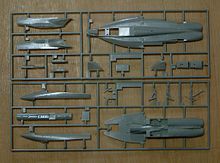
From an early age, I was interested in building scale models, usually of battleships and airplanes, including the B-17. I haven’t bought a model in a long time, but I suspect the plastic parts still look like this:

All the parts are molded together using what is called a "Cold Runner."

All the parts are molded together using what is called a “Cold Runner.”

The first thing you do is break the pieces out of the runner system and then glue them together. I was about six when I built my first model—which was an aircraft carrier—and one of the first things I learned (the hard way) is that too much glue is far worse than not enough.

For a memory that’s over fifty years old, I can still almost see the special cement oozing from the seam between two parts of the assembly when pressed together. My father would try to wipe the excess away, but it was nearly impossible because the chemicals in the glue partially dissolved the plastic, which discolored and distorted it.

model_on_stand

Model with paint, on a display mount — not mine!

Each kit usually had some special components, either clear plastic that was used for windows, or in the case of automobiles, red plastic that was used for taillights. These pieces were especially ruined by over application of glue, because it would fog up their transparency.

Special paints were offered in little glass bottles with metal screw caps, which you had to apply with fine point brushes. I was content to just put the pieces together, but I always applied the decals that came with the models. They were printed on clear plastic and mounted on wax paper that you dunked in water until you could slide them off and onto the model. Getting these things into position was not the easiest thing in the world.

Another thing I remember was the smell of the special glue, and warnings that it was never to be used in an unventilated area. I wasn’t told this then, but it was to keep me from getting high on the fumes.

It’s astonishing to me that airplane glue still contains dangerous chemicals that merit very serious package warnings. Just about anybody of any age can go into the store and purchase these products. I would’ve thought that in all this time safer replacements would have been found, but apparently not.

As we’ve moved to a virtual world, fewer and fewer young kids are building models—which is too bad. There is something about holding the physical pieces and assembling them that no virtual reality—no matter how sophisticated—can replace.

The business is still alive, primarily driven by adult enthusiasts who are making some pretty sophisticated models. Building one sounds like it might be kind of fun.

Till next time.