Tag Archives: merry-go-rounds

Synchronicity: Merry-go-rounds, Steel Slides, Woodstock, Yasgur Road, Chick-A-Boom, Dick Monda and Popcorn

Max Yasgur’s Farm

After a years-long blogging sabbatical, about ten days ago I posted an article that was inspired by a report of a Florida boy falling out of a roller coaster. (It has since been reported that he’s home from the hospital and recovering.)

That incident brought to mind how dangerous amusement park rides were when I was a kid, which further reminded me of how dangerous school playground equipment was back then (Fifties and Sixties). The resultant blog has pictures of a seesaw, monkey bars, swings, and significantly, steel slides and a merry-go-round.

You can read it by clicking on the post to the right entitled Wing (Winganhauppauge) School-Playground, Islip, NY

Within days of posting, I traveled to Bethel, NY, which is where the original Woodstock Music festival took place in 1969. Beginning in 1994, I started visiting Bethel where reunions of various sizes had been taking place nearly every year.

In the very beginning, they were held on the original festival site (without the owner’s permission), which was a nondescript and mostly forgotten cow pasture. Through the seventies and eighties hardly anyone came, but the 20th anniversary in 1989 sparked renewed interest in Woodstock.

More people came in the early nineties, and in 1994, a big 25th anniversary was scheduled for the original site. Though the formal concert was cancelled at the last minute, thousands of people came anyway, and a pretty big rock show was staged (on six flatbed semi-trailers).

In 1996, a recently minted cable TV billionaire named Alan Gerry (pronounce G like Gary), bought the property and declared the site off-limits. With no place for Woodstock celebrants to go, local businessman, Roy Howard, and his wife Jeryl, offered to allow the newly displaced revelers to camp on their Yasgur Road property.    

That was nice of them, and over the years, The Farm became the place to go in Bethel to celebrate the anniversary. Of note: The Farm is where Max Yasgur lived when he agreed to let the original 1969 Woodstock promoters use a section of his property for the festival (the festival site is about two miles from Max’s modest house, which is still there).

Some years the celebrations at The Farm were large, maybe a couple of thousand people. Others were small, maybe a hundred or so. Whatever their size, Roy and Jeryl dealt with lots of municipal permit and code issues that were unpleasant and costly.

When I go, I camp there. I am familiar with the property, but very soon after I arrived this year, I noticed something: Two Merry-go-rounds (one working, one not) and a steel Slide, both of which are very close in design to those shown in my recent blog.
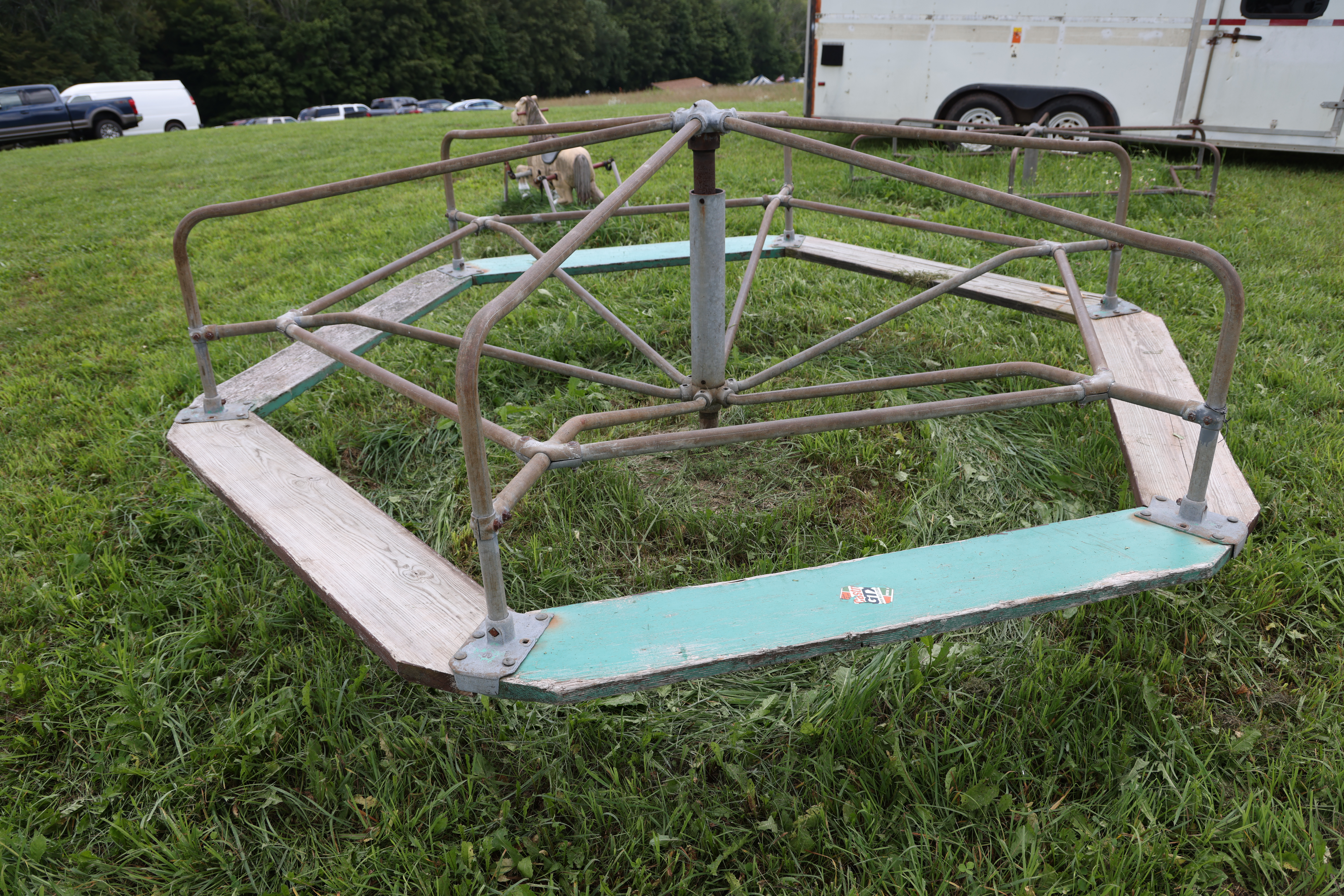
Merry-Go-Round on The Farm (Yasgur Road)

This equipment has been on the property for a while, so I’ve seen it before. Still, it seemed significant that within days of writing about long-forgotten playground apparatus, I found myself camped right alongside it. I took some photos of the equipment.  
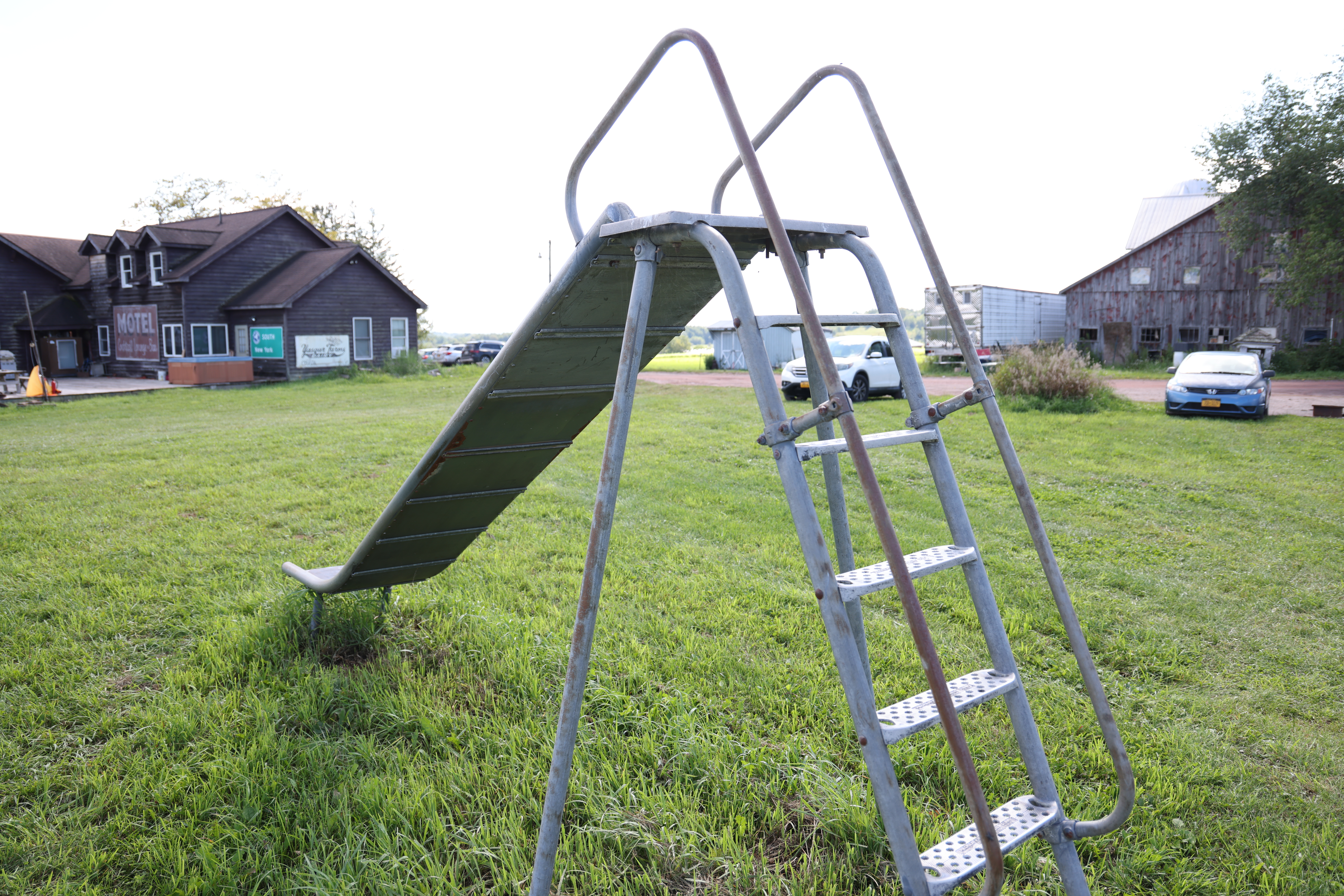
Steel Slide on The Farm (Yasgur Road)

A skeptic might say I wrote about the merry-go-round and slide because I knew I’d be going to Bethel and they somehow rose from my subconscious. I don’t think so. It was the kid falling off the rollercoaster that prompted the post and recollections, so I’m chalking this one up to a very good example of Synchronicity.

Here’s another: WFDU, Daddy Dew Drop, and Chick-a-boom

During the very first week after my visit to Bethel, another odd coincidence occurred. It has nothing to do with Woodstock but makes a musical connection.

In New Jersey there’s a local radio station that is affiliated with Fairleigh Dickenson University. Its call letters are WFDU (listen on the internet: wfdu.fm), and they play a lot of obscure pop songs from the fifties, sixties and seventies. On my first Tuesday back from Bethel, WFDU played a 1971 song called Chick-A-Boom (Don’t Ya Jes’ Love It), by a guy who at the time called himself Daddy Dew Drop.

His real name is Richard “Dick” Monda, who started out as an actor and became a songwriter, performer and music producer. A photo of Mr. Monda if to the right: 

I remembered the song as soon as it came on. It was a massive hit in 1971, reaching number nine on Billboard’s national chart. The song was originally written (by Gwin and Martin) for a television show called “Groovie Goolies,” a program for which Monda had produced music.

I’m not sure if the song ever made it onto the show, but Monda rewrote the lyrics and recorded it with studio musicians. At the time, the story it tells was considered risqué. It recounts a dream where the protagonist follows a girl in a black bikini, who along the way removes parts of it, first the top, then the bottom.

He goes around corners and into rooms, finds himself at a party and comes upon early Rock ‘n’ Roll icon “Little Richard,” (deduced to be him because the lyric reads: “this really far out cat was screaming half-crazy: A-bop-bop-a-loom-op-a-lop-bop-boom,” which is from Richard’s signature song: Tutti Frutti). It might’ve been just some far out cat screaming Little Richard’s catchphrase, but people who comment on such things have assumed it’s Little Richard. Here’s the Chick-A-Boom song:

Daddy Dewdrop’s delivery reminds me of Dr. John, kind of a cool Louisiana drawl, though Monda was from Ohio and grew up in California. It also reminds me a little of Sam the Sham (of Wooly Bully fame, out in 1965) and Tony Joe White (Polk Salad Annie, from 1970, which is such a cool song). Some other internet commenter said Chick-A-Boom reminded him of Eric Burden, and it’s hard to miss the similarities between it and Burden’s “Spill the Wine,” from 1970.

Prior to last Tuesday, I don’t think I’ve thought about the Chick-A-Boom song in at least forty years. Not at all. Not once. The reason songs fade into obscurity is they stop getting played after their time in the sun. That’s what happed to Chick-A-Boom. There’s no explaining why some songs stay in the “oldies” rotation, and others don’t (but it did make it onto the “One Hit Wonders” wall at the Rock ‘n’ Roll Hall of fame.)

A few days after hearing the song, I was at the local Stop and Shop picking up a few things—you know, dinner and stuff. Anyway, I had an urge for popcorn and went to the snack aisle. I am a careful shopper and am always looking for a bargain (as my mother used to say).

The price of snack foods (potato chips, pretzels, corn puffs, corn chips and popcorn) have really gone up lately, and I was scanning the shelves for reasonably priced popcorn. I couldn’t find any. The cheapest was on sale for a little under $4.00, but I figured what the hell, you only live once, and threw a bag into my shopping cart. Here’s a picture of it:

Granted, it would be a more amazing coincidence if the popcorn was called Chick-A-Boom, but damn it, “Boom Chicka Pop” is close enough to put it squarely in the Synchronicity category.

A skeptic might say that the Chick-A-Boom song was floating around in my subconscious and that was what drove me to buy the Boom Chicka Pop brand. I would say I bought it because of its low price, but who the hell knows when it comes to subliminal motivations which nobody really understands. After all, the brain is a pretty complex and mysterious thing.

But still, it seems the universe is sending messages. If only it would include next week’s lottery numbers.

Until next time patient reader, adieu.        
Wing (Winganhauppauge) School Playground, Islip NY

Winganhauppauge School Playground – Islip, NY

The subject of playgrounds came up the other day. It started with news of a child falling off a rollercoaster in Kissimmee Florida. We were surprised because people are usually “yoked” into modern rollercoasters. (From what I’ve since seen, I don’t believe yokes were used on this ride).

This led to my reminiscing over how inadequately I was held into Coney Island’s Tornado rollercoaster back when my mother took me on it when I was about five (around 1957 or so). The restraint was an approximately 3/8ths inch metal bar that was pressed and locked across both rider’s laps, which could be pretty far away from a child’s body if riding with an adult. The coaster terrified me, but that didn’t keep mom from laughing like crazy as the two of us were tossed about in the rickety wooden cab.

The Tornado and the larger Cyclone were part of what is generally called Coney Island, which offered all kinds of entertainment, including “fun houses,” bumper cars, risqué burlesque shows, games of skill and chance, photographers (where my grandmother told me poor people went for family portraits, of which we have a couple), and a variety of places to eat (Nathan’s hotdogs are still sold there). Its boardwalk abuts a three-mile-long public beach.

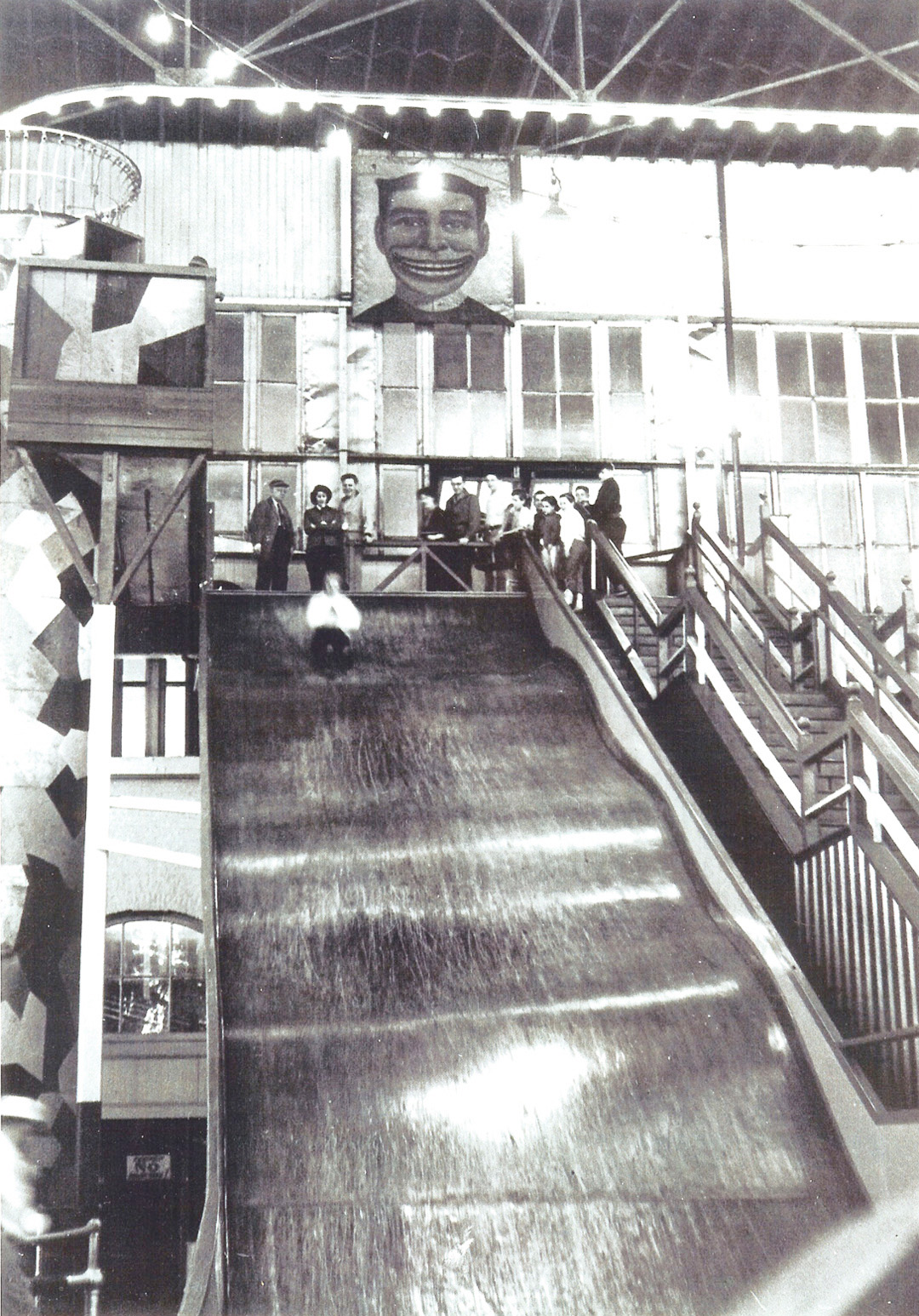
It was also once home to a place called Steeplechase, which opened in 1897, had a couple of fires and as many rebuilds, and closed for good in 1964. Steeplechase was a very large building with mostly indoor rides, many quite dangerous.

After we moved from Brooklyn to Islip, Long Island, New York, I became a paperboy for Newsday, who arranged a visit back to Coney Island and Steeplechase as a reward for signing up new subscribers.

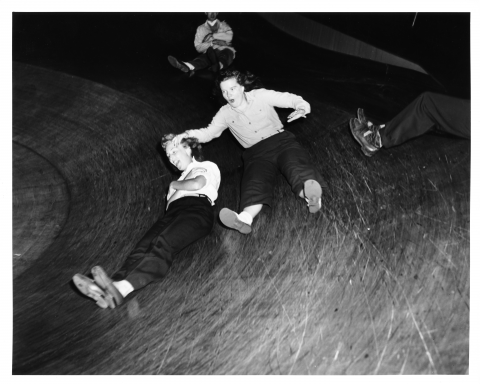
Inside Steeplechase there was what was considered at the time a giant slide, whose surface was like a “gym floor.” At the top riders were given pieces of burlap, and an attendant helped you arrange it into sort of a cloth toboggan. You were cautioned not to put your bare shoe against the slick floor as it might launch you into a painful tumble to the bottom.

If you made it safely down, you went sliding into large bowl, made of the same slick “gym floor” material.

This was supposed to be part of the fun, which rumor had it might include dresses flying up in the air. But it wasn’t all fun and games. There weren’t any pads or mats on the edges of the bowl, and you could easily conk your head against them. As more bodies came flinging into the bowl, it was smart to scamper out of their way as quickly as you could.

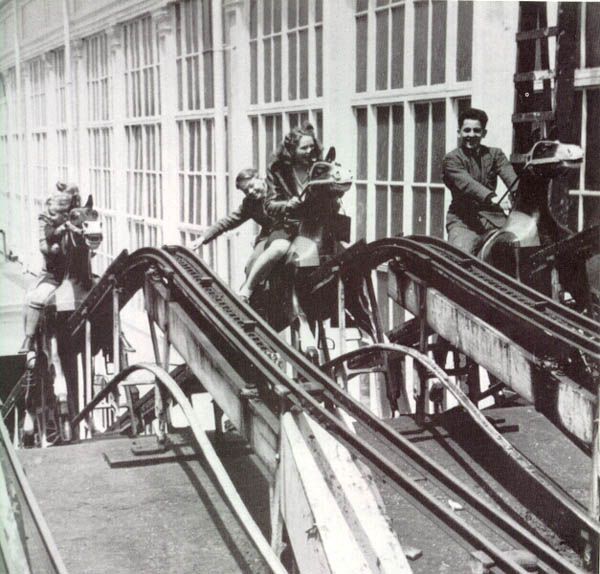
Another ride was “The Steeplechase,” which were these wooden or ceramic horses that you got on and raced around the outside of the building.

The only safety gear was a leather strap they put around your waist, and it was obvious that you could easily slide out of the saddle. At its best, the strap might tether your dangling body to the horse until it stopped. Let’s face it, It was a different time.

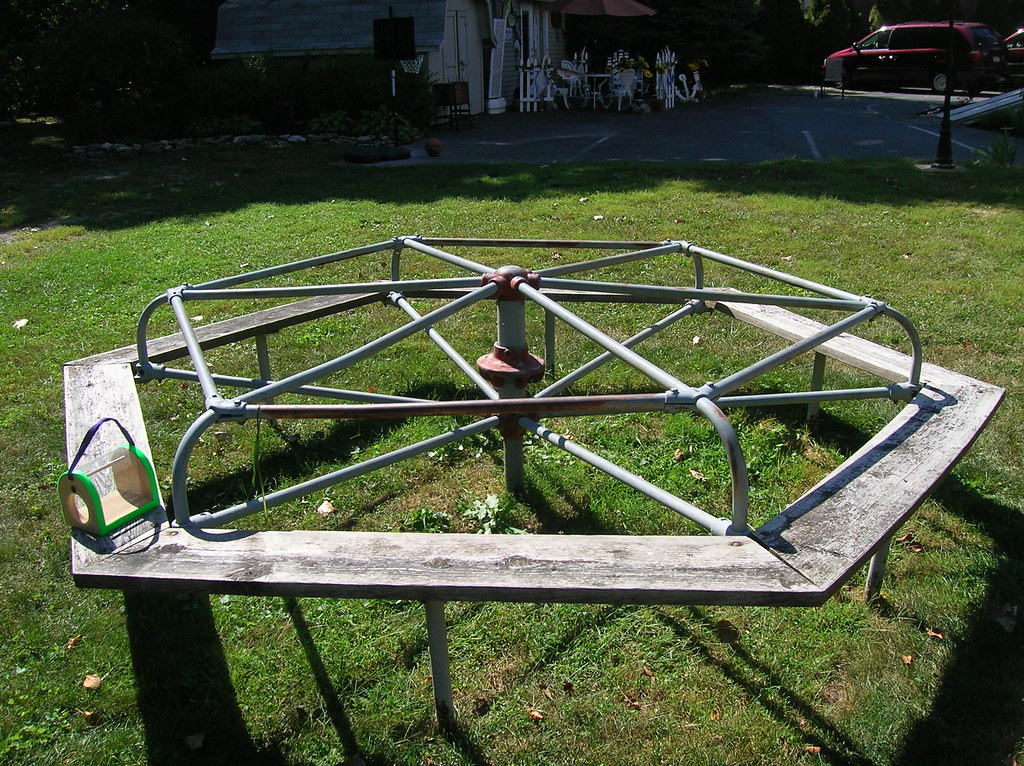
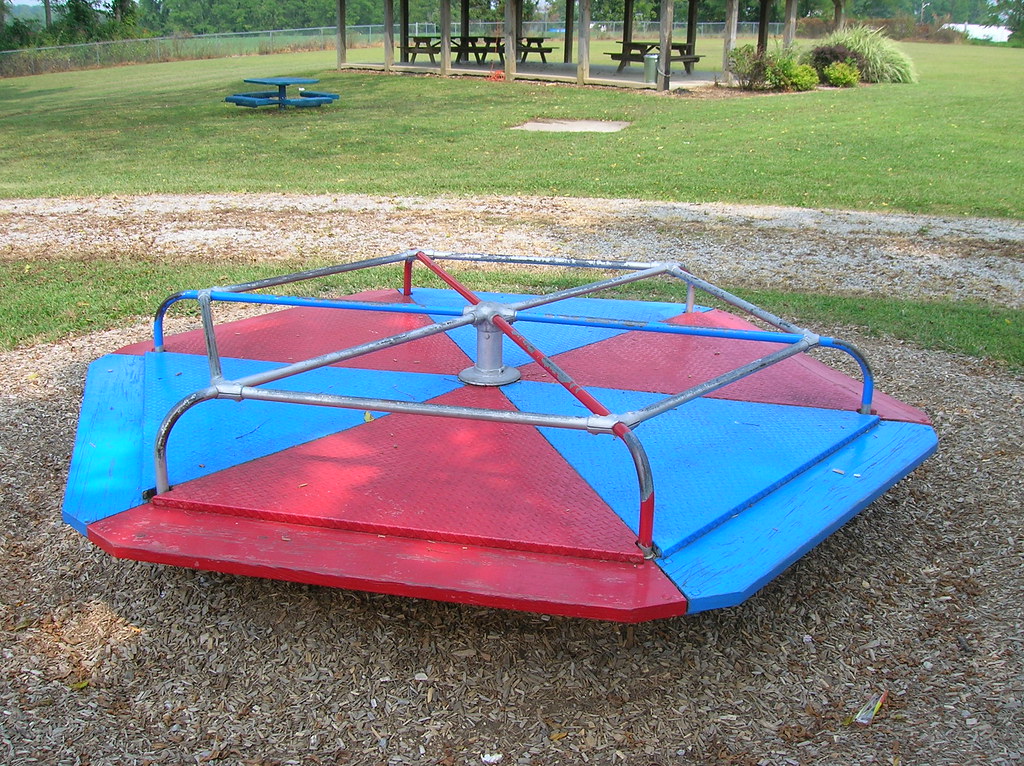
Recollections of these dangerous amusements reminded of the merry-go-round that was on the playground of the Winganhauppauge School in Islip. I don’t think anyone has a picture of the actual ride, but I found one that I think is close.

Me and several other male class members of the class would run and get it spinning as fast as we could, and then leap onto the wooden seats. When it slowed down, we’d jump off and get it going again. This was fun, but there was another reason we did this: it was to terrify the girls and impress them with our immature antics. I don’t think this worked very well.

If a rider somehow found themselves in the center of the spinning contraption, it could easily break their arm or leg, cut them or seriously injure their head. I don’t remember this ever happening, but that doesn’t mean it didn’t.

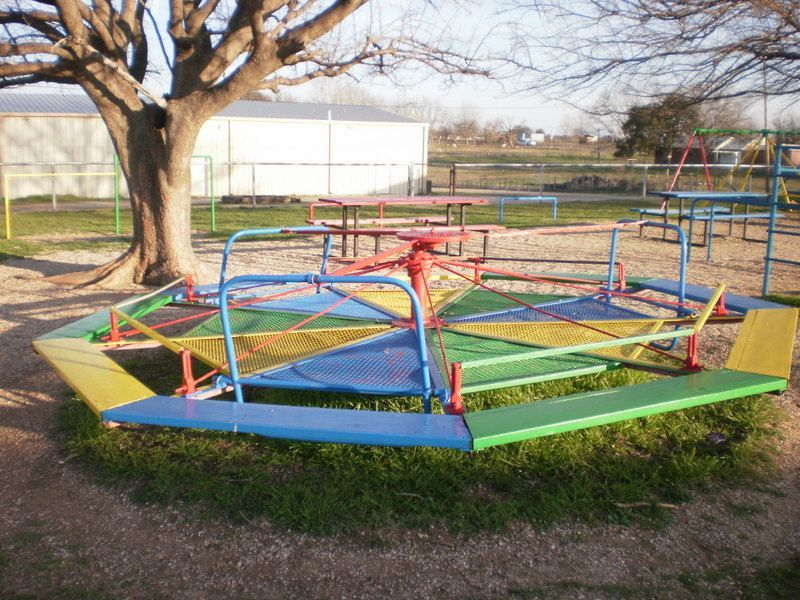
Other versions of these things were made in an attempt to make them a bit safer, like the one below where the spokes slope upward from the center, whereby they might pass harmlessly above your prone body. If you landed closer to the axel however, you were still in for a pretty thorough body of head thumping.

Some “safety fanatic” engineer, came up with the idea of covering the center of the whirling horizontal windmill, making it impossible to fall into its center. However, sitting on it looks like it would’ve been awkward and uncomfortable.

Nor did it address the issue of the centrifugal force flinging you off the spinning discus as prepubescent boys mocked you for your inability to hold on.

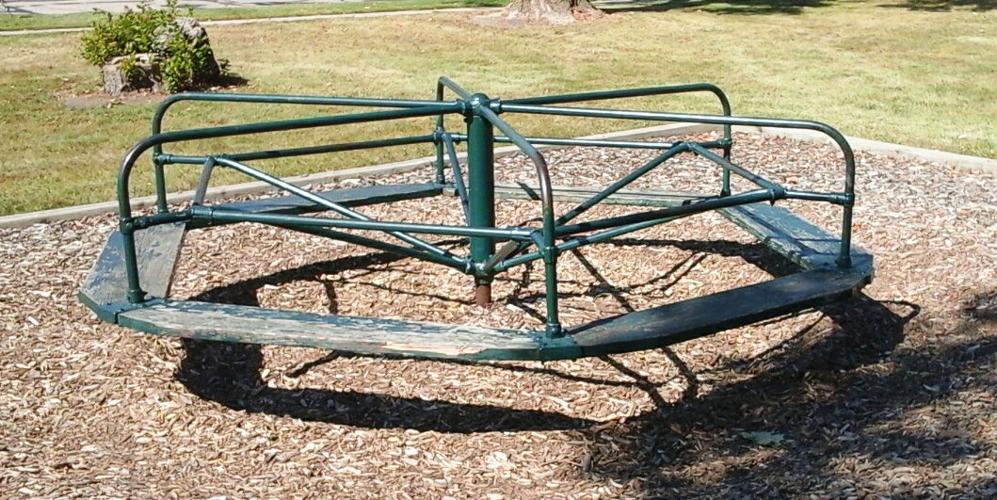
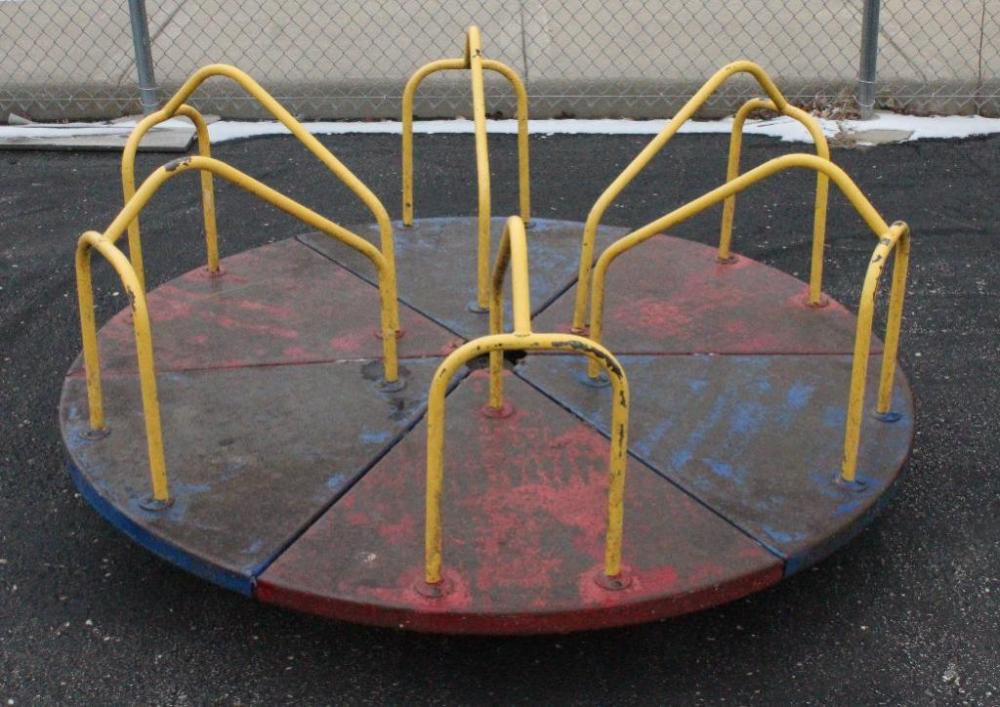
The halfway design change below strived to preserve a child’s ability to sit facing inward while protecting them from the treacherous spokes.

The problem is that the gap for legs is wide enough for a lot of kids to slide all the way through and get mauled by passing little feet or sections of the rotating iron beams.  

Another “safety nanny” thought up a solution where the whole thing was brought closer to the ground, so at least you couldn’t fall in or under it (I hope!).

With this change, you had to stand as you spun, which I guess is okay. You could still get flung from the spinning platter, but you wouldn’t fall as far. If you stood at its side and leaned in, the iron handrails could whack you in the head—but you’re not supposed to do that!

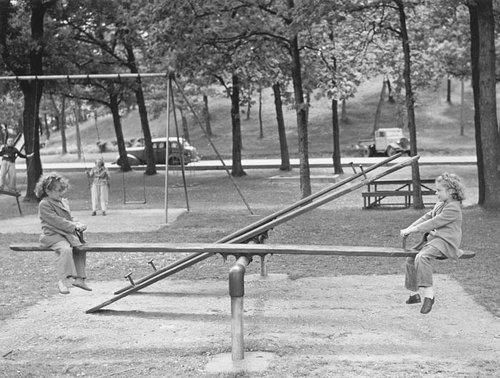
But it wasn’t just the merry-go-round that was dangerous. Seesaws were plenty treacherous.

I loved them, until the day a fellow classmate thought it would be “funny” to slide off his end when I was at maximum height. This sent me into a spine-compressing deadfall that was excruciating and probably actionable.

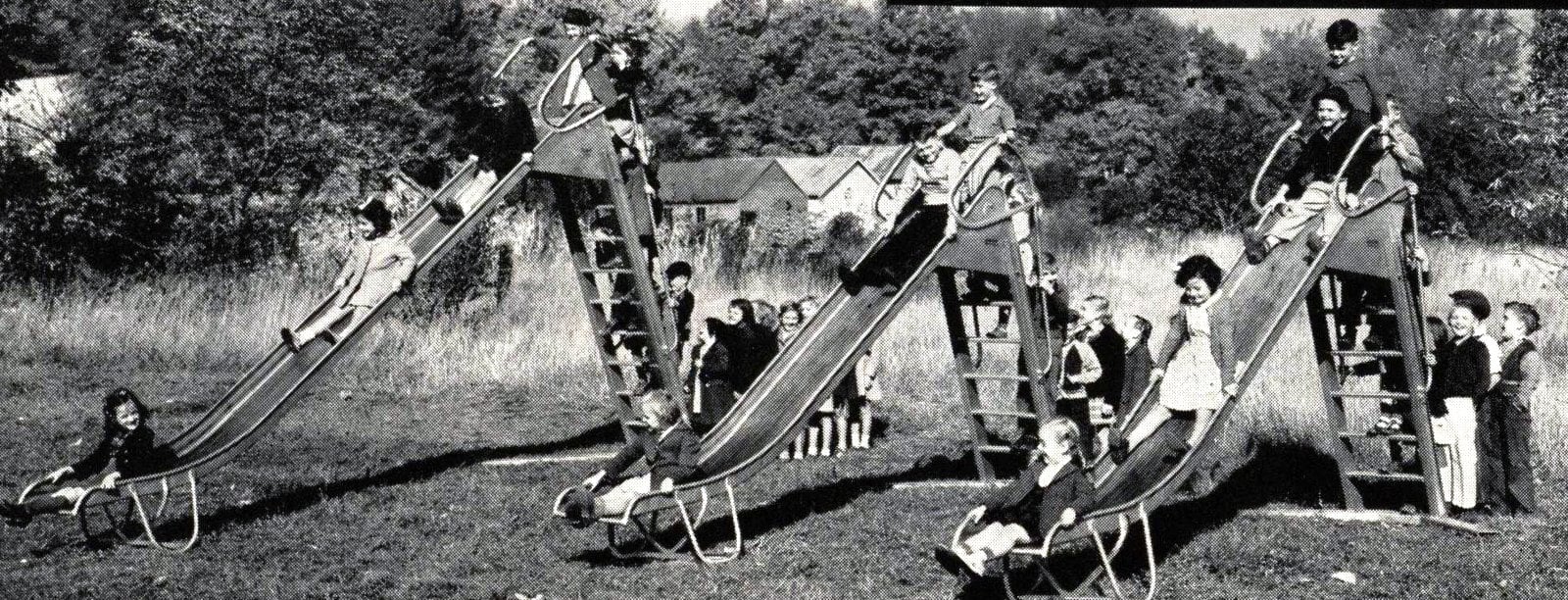
And then there was the steel slide, that as I recall was probably over ten feet tall.

At the top, there was a moment when you briefly stood as kids behind you moved and jostled their way for the next position. When you sat down, you might experience the 160–175 degree temperature (some say 200 degrees) that steel slides reach when exposed to direct sunlight. At least us boys had pants on.

The objective was to go down as fast as possible, so some of us lifted our legs and slid on our backs, launching us off the end of the slide into a hard back landing. It was wise to quickly move aside as there were other kids coming in hot from behind.

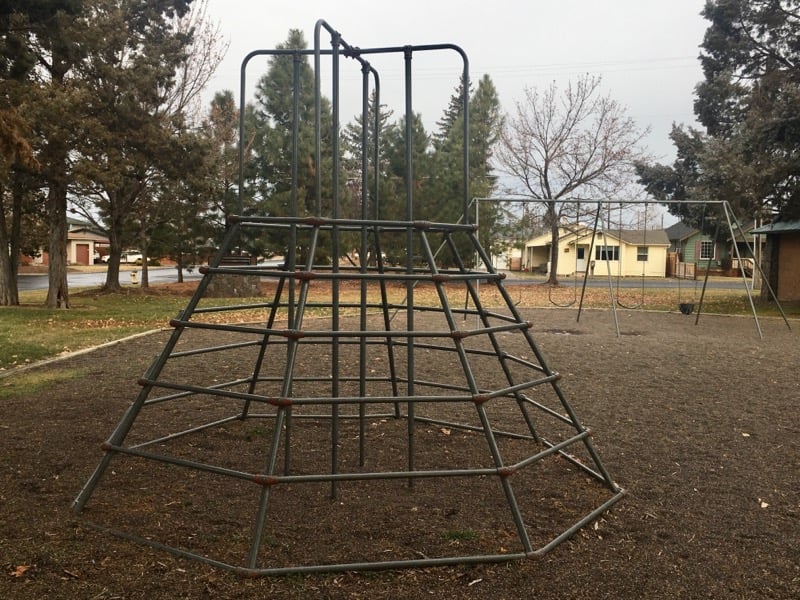
And then there were the monkey bars, which at Wing had four poles in the center down which we slid. I believe this set is a perfect match for the ones at Wing.

Some of the more athletic kids liked to climb and stand on the very top of the jungle gym. Other kids (boys again) opted to thrill us with their Superman impersonations by jumping off the top rungs. Why weren’t they stopped?

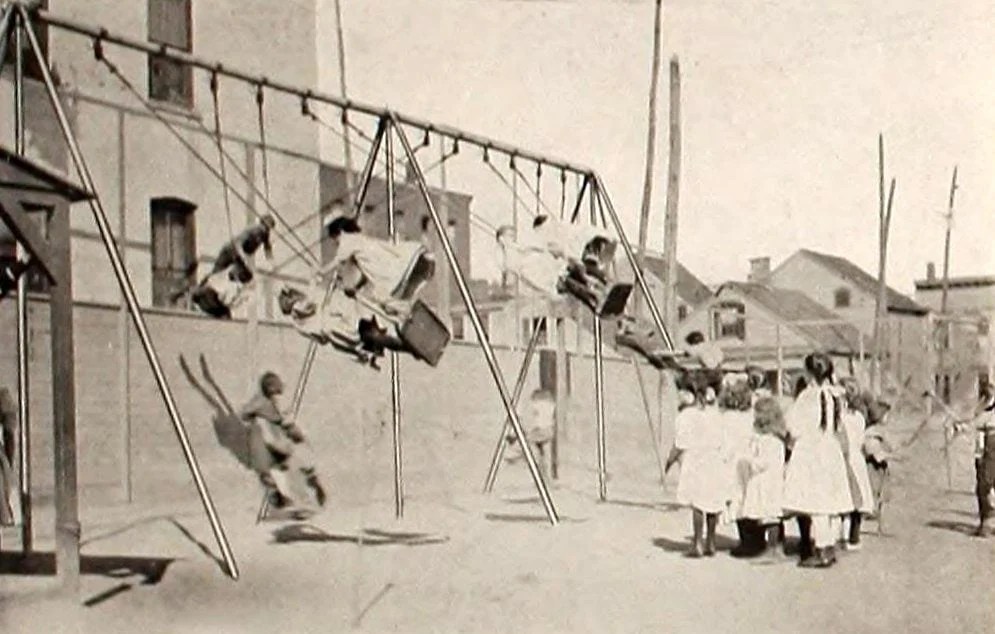
And then there were the swings, which I remember as being pretty high, but nothing like the ones down at Islip Beach, which were fantastic! The ones shown to the right are like the ones at the beach. Wing’s were lower but still pretty respectable.

I need to mention that the playground at Wing was enclosed by a gated, four-foot, chain-link fence, and the ground was covered with sand, which I’m sure stray cats loved to visit.  

One night me and some friends were hanging out at the playground. We were probably in seventh or eighth grade, but still enjoyed riding the swings. One of my more daring friends displayed his acrobatic chops by swinging very high, and at the maximum of his backswing (that place where you’re neither rising or falling), he leaned forward and dropped onto the sand.

The first time he did it, he landed on hands and knees, but after a while, took it a step further. At that “still” section of the backswing, he somersaulted forward and landed this time on his feet.

I had done the relatively tame “drop” maneuver but left the flips to my more acrobatic chums. But another of them, however (and I will not repeat his name to save him from embarrassment), wanted to give it a go.

His attempt started reasonably well. At the maximum point in the backswing, he leaned forward and began his flip, but it stalled when he was completely upside down! My memory of this goes in slow motion.

As his body dropped closer to the sand, it was clear that he was going in for a full faceplant. If my friend was a female yoga teacher in a black leotard, the figure below shows about how he landed, except for the outstretched arms and the fancy watch.

There were a few silent moments after this, as most of us thought we had just watched someone die. Miraculously, soon after our chum’s inverted body toppled over, he was kneeling, appearing stunned, angry, in pain and mortified. With the tips of his fingers he gently wiped sand from his somewhat rearranged face, and it was plain that getting it out of his eyes was going to be a problem.

Somebody asked if he was okay, and he must have heard the small measure of mirth behind the question, which threw him into a rage. Who’s laughing, he loudly demanded, which for me and the rest of the lads was invitation enough to begin a round of merciless and derisive laughter. It went on for quite some time.

The fenced-in playground is long gone, but even in light of what would now be considered a total disregard for our safety, it still holds many fond memories for me.

Yes, it was a different time. ‘Till next time.